How Many Feeders Do I Need? Counting Line Items, Not Placements
Every feeder count I have had to defend came down to the same mistake, and it is a cheap one to make: counting the parts on the board instead of the part numbers on the BOM. On the boards I have counted, those two figures differ by a factor of five, and the gap decides whether a job runs in one pass or three.
One feeder per unique part number
OpenPnP's user manual states the rule plainly: "you don't need a feeder for every placement. Even if your board have 100 0603 red LEDs, you just need to set up the feeder for that part once."
Unique means manufacturer part number, and the manual draws that line where you would draw it: "a 10k 0603 5% resistor and a 10k 0603 1% resistor are two different parts." Same value, same package, different tolerance, so the reel already loaded in a feeder will not do for the second one. Value, package, tolerance, voltage and anything else that changes the order code splits a line item, and the feeder count follows the line items.
The method is short. Pull the BOM, sort by manufacturer part number, count the rows. That number is your feeder count before tape width, spares and a second pass get involved.
Four boards, counted from their design files

I counted four boards from the open LumenPnP hardware files to see how far the two figures drift apart. The method, if you want to repeat it: read the footprint blocks in the .kicad_pcb file, group them by value and footprint, merge case variants such as 10k and 10K, and leave out fiducials, test points, mounting holes and silkscreen art.
| Board | Placed parts | Actual components | Unique line items |
|---|---|---|---|
| Limit switch board | 5 | 3 | 3 |
| Slot harness blade | 47 | 38 | 5 |
| Feeder mainboard | 71 | 58 | 38 |
| Machine mainboard | 396 | 296 | 66 |
The slot harness blade makes the point without any help. One blade carries twelve DS28E07 one-wire EEPROMs, twelve 1 MΩ 0805 resistors and twelve spring-pin contacts, one contact per feeder slot, plus a JST PH connector at each end of the chain. That is 38 components from four reels, since the EEPROM, the resistor, the spring pins and the connector each come on one. The board file lists five line items only because the two connectors use their silkscreen labels, IN and OUT, as their value field, and a silkscreen label is not an order code. Cost per part number, not per placement, is the point to take away.
The feeder mainboard is the realistic case for anyone building feeders in batches: 71 placements, 58 components, 38 part numbers. Those figures alone are the reason to buy feeders in four-packs rather than one at a time.
The machine mainboard is where the count breaks the machine. 396 placements and 296 components compress into 66 part numbers, so 66 reels are needed and the machine has 50 slots. Even at one slot per feeder, that board cannot be built in a single pass. Two passes with a reel change in the middle, or the rare parts hand-fed from cut tape, is how it actually goes together.
Slots, tape width and the 50-slot ceiling
A Vertex 4 has 50 feeder slots, and the slot cost of a feeder depends on its tape width. The 8 mm and 12 mm feeders take one slot each. The 16 mm and 24 mm feeders take two, so a four-pack of 24 mm feeders occupies eight slots.
That gives a formula worth writing on the wall:
slots needed = line items + (line items wider than 12 mm)
The machine mainboard needs 66 slots before any wide-tape penalty. If a third of those 66 parts arrive on 16 mm or wider tape, a normal mix, the requirement lands near 88 slots and the job is spread across two runs whatever you do.
Slots are addressed, and the addresses run in order. Slot numbers 1 through 25 sit on the front rail and 26 through 50 on the back, the number is the feeder's address, and slot 1 sits 85 mm from the front left leg. Slot 50 is a different color and goes on last in the harness, because the chain has to terminate there for the feeders to talk. Mount them out of order and you spend an evening re-seating a harness.
Feeder addresses are also why the mounting order in Mounting Feeders mirrors slot order rather than filling gaps as they appear.
Where the count climbs past one feeder per part
One feeder per part number is the floor, not the answer. Five things push the number up, and they push it by slots, not by parts.
A spare of a high-run reel. OpenPnP supports several feeders for the same part, and it moves to the next one when a reel runs empty. Hot parts are worth a second feeder so a 400-placement run does not stop at reel three. On 8 mm and 12 mm tape that spare costs one slot, and two slots on the wide tape.
A second side. Flip the board and you run the second pass, which means either a second set of feeders loaded for the bottom side or a re-load between passes. Overlapping part numbers between the two sides let you skip the duplicate feeders.
Feed failures on a long run. A feeder gets a few attempts to feed, set by the Feed Retry Count in its configuration, and gets disabled when it keeps failing. OpenPnP's job processor carries a Feeder Fault Limit as well, which by default disables a feeder when 3 of the last 6 placements from it go wrong, and the rest of the job keeps running. A disabled feeder at 3 am on a 300-board run is a production stop for that part. The cheap insurance is a spare feeder of the same part, in the same tape width.
Parts that will not earn a slot. A part placed once or twice per board does not need a reel. A strip feeder is a piece of cut tape stuck to the bed with double-sided tape, and it uses no slot at all, which is the usual way to cover the tail of a BOM. Loading one is covered in Loading Tape.
Electronics channels. On the AS feeder line, one AS_FCB_V1.0 control board drives up to 16 feeders, so a setup past 16 feeders on that line needs a second control board regardless of how many slots are free. The 50-slot figure is a machine ceiling; the 16-feeder figure is an electronics ceiling, and the lower one applies.
Sizing a first purchase
The arithmetic above turns into a short buying path.
Four feeders covers a board with four part numbers: a couple of passives, an LED, an IC. The 8 mm Starter Kit at $219 gets there with the FD_USB_HUB tool board and the 16-channel AS_FCB_V1.0 control board in the box.
Eight to twelve feeders covers most hobby and prototype boards, and past sixteen the counting starts to matter more than the buying. The powered feeder four-packs are $299 in 8 mm and 12 mm, $319 in 16 mm and $329 in 24 mm. The AS2 servo feeder four-packs are $199 in every width.
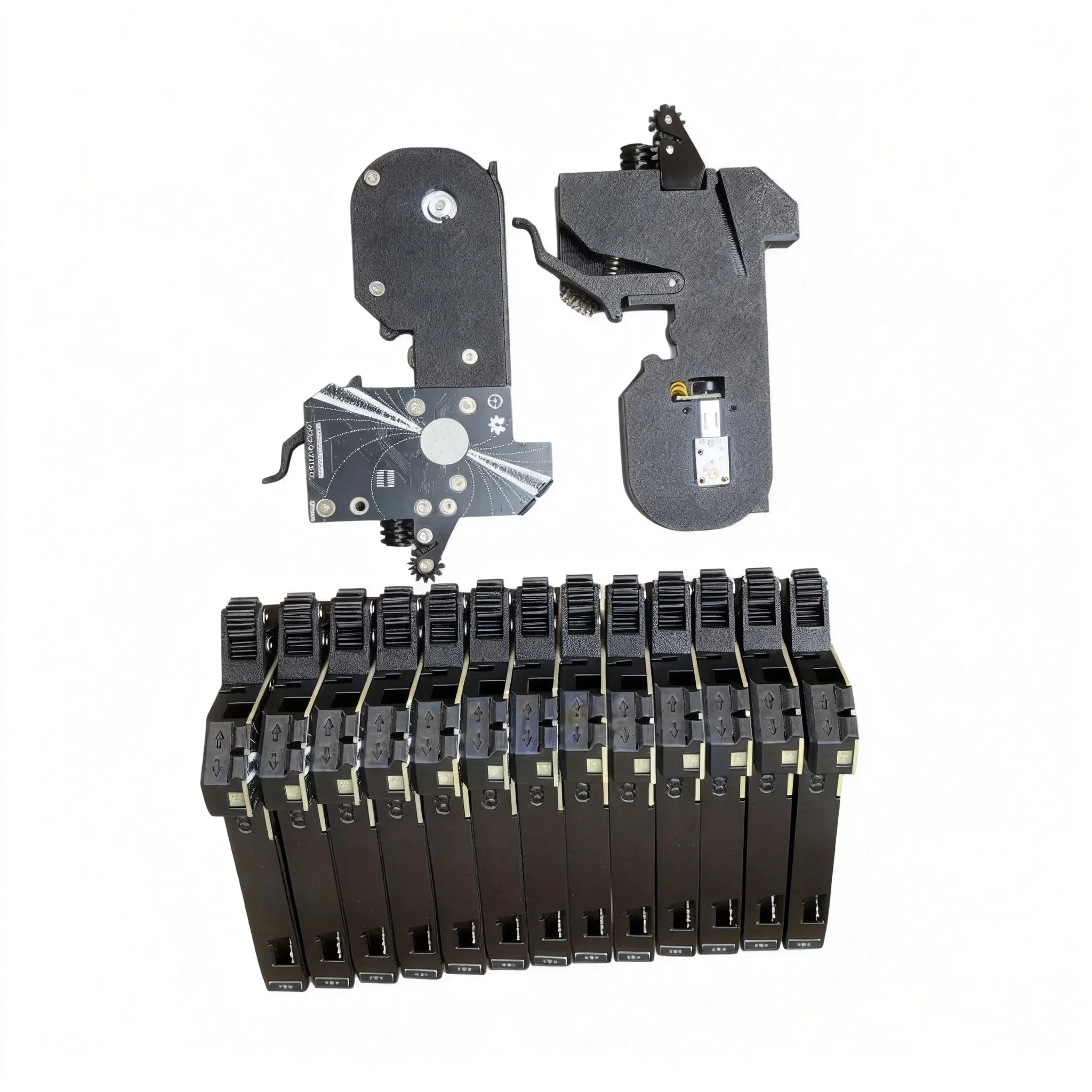
Two prices are worth keeping apart, because they point in opposite directions. Per feeder, the 8 mm powered feeder costs $74.75 and the AS2 costs $49.75. Per slot, the ranking flips: an 8 mm powered four-pack takes four slots at $74.75 each, while a 24 mm four-pack takes eight slots at $41.13 each. Tape width is therefore the cheaper way to add slots and the more expensive way to add part numbers, which is why the advice in 8 mm vs 12 mm tape is to stay narrow unless the part demands otherwise.
A Vertex 4 ships with one set of manual tape feeders, so the first few part numbers can be fed by hand while you decide which widths to buy.
The count before you order
- Count line items from the BOM by manufacturer part number, not placements.
- Mark every line item on 16 mm or wider tape. Each one costs two slots.
- Add a spare feeder for any part whose reel is shorter than the run.
- Note whether the board is double-sided, and whether the two sides share part numbers.
- Compare the total against both ceilings: 50 slots on the machine, 16 feeders per AS control board.
- If the total lands just under a ceiling, move the rare tail of the BOM to strip feeders instead of buying slots for it.
That count is also the one worth putting in your OpenPnP setup notes, since a feeder table built on the part-number count keeps working when you swap a reel for a different tolerance. Feeder Overview covers the hardware side, and the OpenPnP Feeder Guide walks through configuration.