CP40 Nozzle Numbers vs Juki 5xx Nozzle Numbers
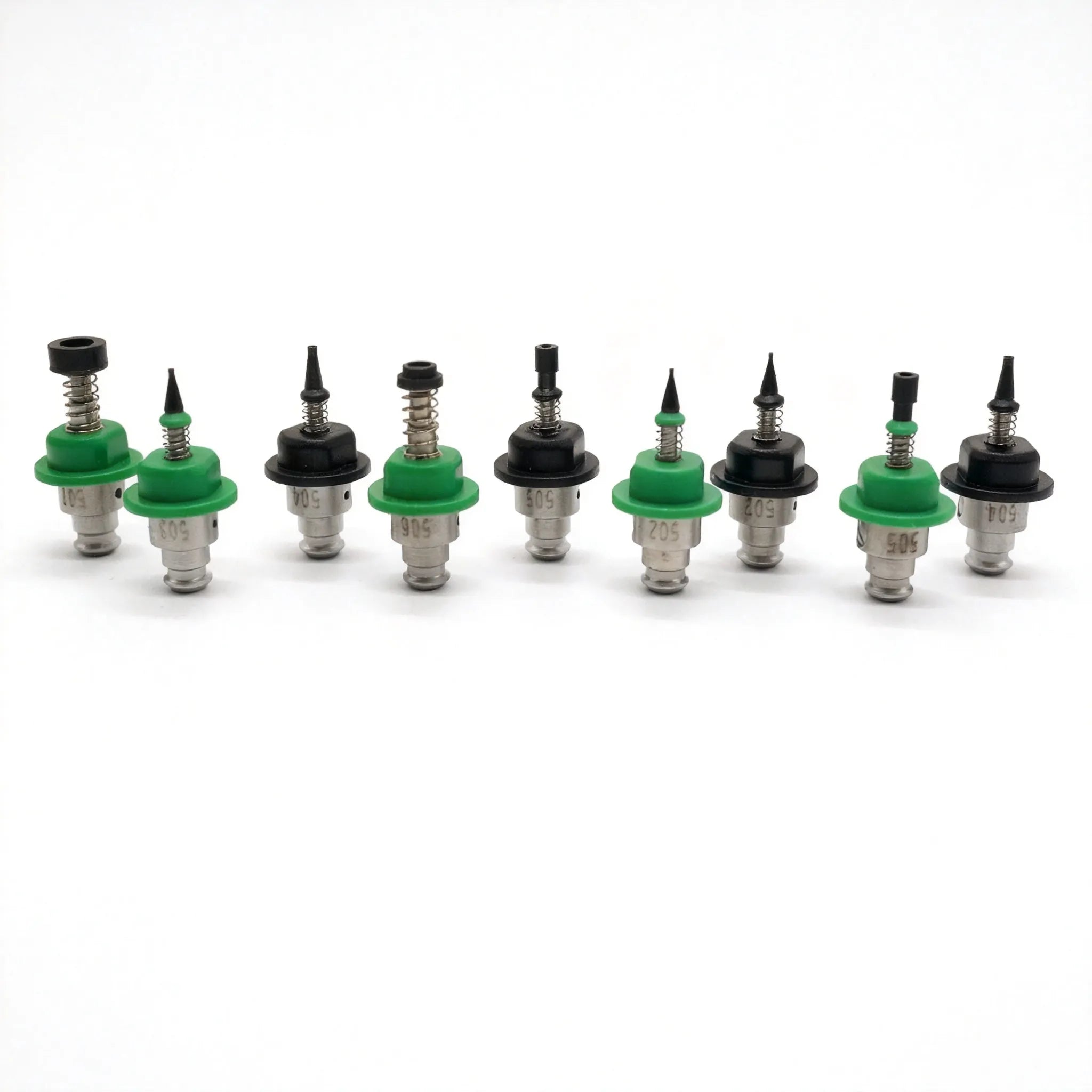
Two nozzle families show up on the same class of desktop machine, numbered by two unrelated ideas. Opulo's LumenPnP ships with CP40-style tips. The PikkoBot Vertex 4 head takes Juki-compatible nozzles. OpenPnP names its nozzle tip objects after the first family, so a machine can report an N045 loaded while a 503 sits on the spindle.
Neither chart converts into the other, and the numbers look deceptively similar once you are staring at a parts listing at 11 pm. Here is what each family actually encodes, with the dimensions behind both.
How a CP40 name is built
A CP40 tip name is its bore diameter in millimetres with the decimal point removed. N045 has a 0.45 mm opening, N08 has 0.8 mm, N24 has 2.4 mm. The outer diameter never appears in the name, and for this family it runs at roughly twice the bore.
Six sizes cover the LumenPnP's range. Dimensions and part numbers below are what Samsung/Hanwha nozzle distributors list for these tips (N045 through N75 are stock numbers 2101938 to 2101943).
| Tip | Outer | Bore | Aperture area | Samsung part no. |
|---|---|---|---|---|
| N045 | ⌀1.0 mm | ⌀0.45 mm | 0.159 mm² | 2101938 |
| N08 | ⌀1.5 mm | ⌀0.8 mm | 0.503 mm² | 2101939 |
| N14 | ⌀2.7 mm | ⌀1.4 mm | 1.539 mm² | 2101940 |
| N24 | ⌀4.0 mm | ⌀2.4 mm | 4.524 mm² | 2101941 |
| N40 | ⌀6.2 mm | ⌀4.0 mm | 12.566 mm² | 2101942 |
| N75 | ⌀9.0 mm | ⌀7.5 mm | 44.179 mm² | 2101943 |
The outer-to-bore ratio holds between 1.2 and 2.2 across all six, so once you know one dimension you can estimate the other and sanity-check a listing before ordering.
How a Juki 5xx number is built
Juki's 5xx family runs 501 through 508 in size order, and the digits are an index into the catalogue. A 503 tells you nothing about millimetres; the tip geometry and the component width it is rated for are separate columns in Juki's Nozzle Application Catalogue (Rev C3).
| Nozzle | Tip outer | Bore | Component width |
|---|---|---|---|
| 501 | 0.7 × 0.4 mm flat face | two ⌀0.2 mm holes | D < 0.45 mm |
| 502 | ⌀0.7 mm | ⌀0.4 mm | 0.45 ≤ D < 0.75 mm |
| 503 | ⌀1.0 mm | ⌀0.6 mm | 0.75 ≤ D < 1.45 mm |
| 504 | ⌀1.5 mm | ⌀1.0 mm | 1.1 ≤ D < 2.5 mm |
| 505 | ⌀3.5 mm | ⌀1.7 mm | 2.5 ≤ D < 4.0 mm |
| 506 | ⌀5.0 mm | ⌀3.2 mm | 4.0 ≤ D < 7.0 mm |
| 507 | ⌀8.5 mm | ⌀5.0 mm | 7.0 ≤ D < 10.0 mm |
| 508 | ⌀9.5 mm | ⌀8.0 mm | D ≥ 10.0 mm |
The full table, including part numbers, is on Juki Nozzle Compatibility, and the boundary between 0201 and 0402 parts is worked through on 501 vs 502.
The outer-to-bore ratio drifts here: 1.75 on the 502, 2.06 on the 505, 1.19 on the 508. The 501 does not even use a round bore, since its face carries two small holes instead. Two systems drawn up by two companies, with no shared reference dimension.
Where the ranges land side by side
Same outer diameter, different pull. N045 and 503 both measure 1.0 mm across the tip face. The bores are 0.45 mm and 0.6 mm, so the apertures are 0.159 mm² and 0.283 mm². The Juki tip moves 1.8 times the air area at the same footprint, which is the sort of difference worth measuring on the machine when a pick sits near the boundary of working.
Higher up the ranges, the gap widens. N24 brings 4.52 mm² against the 505's 2.27 mm², at an outer diameter of 4.0 mm against 3.5 mm. At the top end, N75's 44.18 mm² falls between the 507's 19.64 mm² and the 508's 50.27 mm².
There is no conversion table, official or otherwise, and no shared numbering that lets you order across families. Picking a number from the wrong chart gets you a tip of about the right size with the wrong aperture, which is a harder fault to spot than an obvious mismatch, because it usually still picks.
How each one attaches to the machine
A CP40 tip pushes onto the nozzle and is held by O-rings. Opulo's install guide has you lubricate those O-rings first and warns about the amount, since the openings are small enough that excess grease clogs the tip. Fingers on, fingers off, no tools, and the tip is the whole part.
The Juki side adds a holder between the tip and the head. On a Vertex 4, the nozzle seats on a brass adapter sleeve on a hollow-shaft stepper, which is why the parts come as an assembly: connecting rod, 28 mm stepper, 4 mm pneumatic fitting, nozzle. A worn or snapped tool is an assembly replacement, and a bent or clogged tip is a tip replacement.
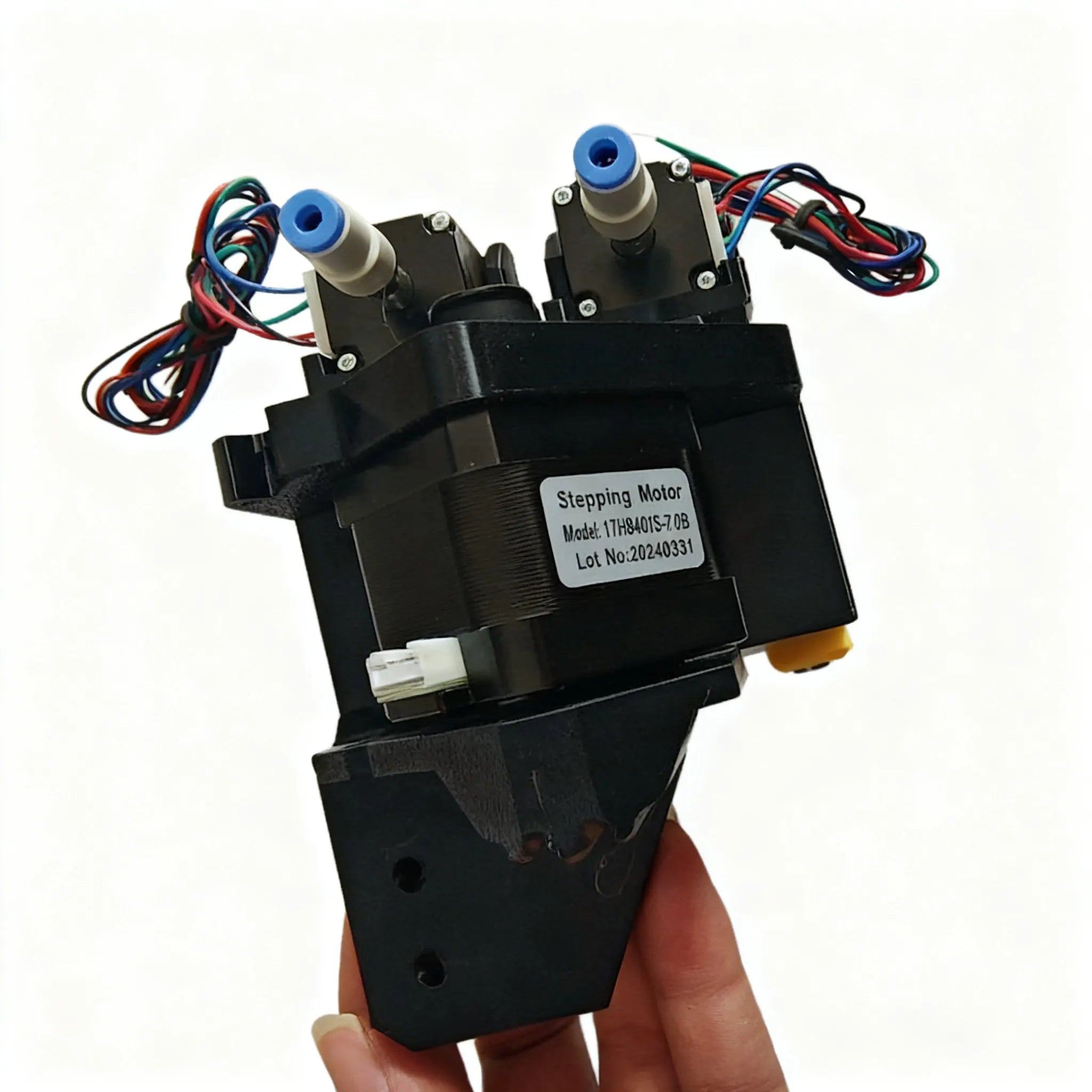
Current PikkoBot pricing, straight off the store listing: six-tip set at $69, single nozzle assembly at $49, dual head module kit at $239, on a $1,499 Vertex 4 that ships with 503 and 505 fitted and 50 feeder slots to fill. Opulo lists its own six-piece CP40 tip set at $75 with the printed holder rack.
What to check before ordering
- Which family does the head take? A push-on tip, or a nozzle with a holder, connecting rod and fitting. The Vertex 4 is the second kind, and the head module's brass adapter sleeve is the part that defines it.
- Convert the number before comparing it. N045 is a 0.45 mm bore. A 503 is a 0.6 mm bore with a 1.0 mm outer diameter. Write the millimetres down and the two charts stop being confusing.
- Tips or assembly? The six-tip set is tips only. It has no rod, motor or pneumatic fitting in it, so it widens your range and does not repair a broken tool.
- Check the finish. PikkoBot ships nozzles black by default, because nozzle tip calibration on the bottom camera reads a dark tip more reliably against the datum board. A bare-metal tip from another source can calibrate badly on the same machine.
Why OpenPnP shows CP40 names
OpenPnP keeps a nozzle tip object per tip, with min. part diameter, max. part diameter, max. part height and max. pick tolerance attached to it, and bottom vision crops its search window from those four numbers. The stock PikkoBot configuration names its two tip objects N045 and N24, following LumenPnP convention, while the head carries Juki tips. The label in the tree describes the slot in the LumenPnP family tree, and the hardware on the spindle decides what actually gets picked.
That mismatch is harmless until a calibration runs against the wrong tip object, at which point the machine trusts numbers that belong to a tip it has never had mounted. Which object is loaded is worth checking before any nozzle work, and the swap order covers what each swap invalidates. Slot and feeder capacity, if you are working out how far a nozzle range actually gets you, is on Feeder Overview. Other pick faults that look like a nozzle problem are collected in the FAQ.