Desktop SMT or a Board House: Where the Crossover Sits
Five assembled boards arrive, the assembly line on the invoice reads $129.10, and the per joint rate the decision was based on accounts for $2.73 of it. The rest went to a setup fee, a stencil and feeder loading charges that get paid once per order however many boards are in it. That fixed block is the number to weigh against a machine on your bench, because it comes back every time you send out a revision.
The rates below are JLCPCB's published ones, read on 2026-10-01. The joint counts are mine, pulled out of open source board files. The arithmetic joining the two is written out in full so you can swap in your own BOM and your own quantity.

Published rates
| Cost item | Economic PCBA | Standard PCBA |
|---|---|---|
| Setup fee | $8.18 | $25.56 single side, $51.12 double side |
| Stencil | $1.53 | $8.21 single side, $16.42 double side |
| SMT assembly | $0.0016 per joint up to 100,000 | $0.0016 per joint to 50,000, then $0.0013 to 100,000, then $0.0012 |
| Manual assembly | $0.0164 per joint to 10,000 | $0.0164 per joint to 10,000 |
| Feeder loading | $3.07 per extended part number | $1.53 per part number |
| Hand soldering labour | $3.50 per order | $3.50 per order |
Two details from the same pages matter here. Parts in their Basic and Promotional Extended library carried no feeder loading fee on Economic, and that category held 1,586 part numbers when I read it. Their cart also enforces a minimum assembly charge for a single board, so a quote that lands under the floor gets topped up rather than honoured.
Count joints, not part numbers
A joint is one pad that receives solder. Every footprint in a board file lists its pads, which makes the count a few lines of script instead of a vendor quote. I ran it across four boards from the LumenPnP open hardware project, all of which are public and can be checked:
| Board | Placed footprints | Line items | SMD joints | Through hole joints |
|---|---|---|---|---|
| xy-limit | 5 | 3 | 6 | 6 |
| blade12 | 47 | 5 | 168 | 0 |
| feeder-mobo | 71 | 38 | 280 | 6 |
| lumenpnp-mobo | 396 | 67 | 1,075 | 89 |
Line items and joints track each other loosely at best. The blade12 board has 5 line items against 168 joints, and the feeder board carries 38 line items against 286 joints, so counting BOM rows tells you very little about the joint bill. Joints per placement sits between 2.9 and 3.6 across the four, which is what two terminal passives plus a few multi pin ICs looks like in practice. And the smallest board on the list, 12 joints across 5 placements, pays the same $8.18 setup as the board with 1,164 joints.
The counts drop fiducials, mounting holes, test points and logos. Those get placed by the machine but they are not on the BOM the way a resistor is, and I left them out of both columns so the arithmetic stays reproducible.
The fixed block decides a five board order
Setup, stencil and feeder loading, added up before a single board is built:
| Board | Any BOM | Half the line items extended | Every line item extended |
|---|---|---|---|
| xy-limit | $9.71 | $12.78 | $18.92 |
| blade12 | $9.71 | $15.85 | $25.06 |
| feeder-mobo | $9.71 | $68.04 | $126.37 |
| lumenpnp-mobo | $9.71 | $111.02 | $215.40 |
The left column is what a BOM built only from Basic and Promotional Extended parts pays. The right column is the worst case, and it is the one that shows up on a real design with a few specialty ICs in it.
Spread that over a quantity and the shape of the problem appears. These are assembly fees only, with components and bare boards excluded from both sides of the comparison:
| Board | 5 boards | 20 boards | 50 boards | 100 boards | 500 boards |
|---|---|---|---|---|---|
| xy-limit | $3.89 | $1.05 | $0.49 | $0.30 | $0.15 |
| blade12 | $5.28 | $1.52 | $0.77 | $0.52 | $0.32 |
| feeder-mobo | $25.82 | $6.86 | $3.07 | $1.81 | $0.80 |
| lumenpnp-mobo | $46.26 | $13.95 | $7.49 | $5.33 | $3.61 |
Per board, the 38 line item board costs more at five boards than the 67 line item board costs at fifty. Quantity and BOM structure pull in opposite directions here, so at prototype quantity the part number count sets the price.
Sixteen extended part numbers flip Economic to Standard
Two published fixed blocks, written as formulas:
- Economic: $9.71 + $3.07 for each extended part number
- Standard: $33.77 + $1.53 for each part number
Standard starts $24.06 behind and closes that gap at $1.54 per part number, which happens at 15.6. At 16 extended part numbers Standard's fixed block is already smaller, and since both tiers charge the same $0.0016 per joint in the first bracket, Standard stays ahead from there.
The feeder board is the test case. $126.37 on Economic against $91.91 on Standard, which at five boards is $25.82 a board against $18.93. Standard also carries solder paste inspection on every order and reaches packages down to 0201.
The standing advice that Economic is the cheap tier holds for a BOM full of Basic parts. Worth checking your BOM against their library before assuming yours is one of those, because the loading fee scales with part number count while the setup difference does not.
What a revision costs on each side
Every respin pays the fixed block again. The stencil goes back on the shelf unused, the setup fee does not come back.
| Board | Fixed block per revision | Revisions that equal a $1,499 machine |
|---|---|---|
| xy-limit | $18.92 | 79 |
| blade12 | $25.06 | 60 |
| feeder-mobo | $126.37 | 12 |
| lumenpnp-mobo | $215.40 | 7 |
On an unchanged design the board house is not beatable on unit cost. The second board of the 286 joint design adds $0.55, and a design with 1,000 joints pays $1.60 for each extra board at that rate. Compared with the board house, a machine on your bench earns its place against two things: the fixed block that gets paid on every revision, and the days that pass before a board comes back.
Work the board house will not take
- Economic takes 2 to 50 boards per order, packages down to 0402, IC pin spacing of 0.4 mm, BGA pitch of 0.5 mm, 2, 4 or 6 layers, single boards between 10 × 10 mm and 470 × 500 mm, and panels up to 250 × 250 mm.
- Standard takes 2 to 80,000 boards, 0201 and 01005 packages, 0.35 mm pin spacing and BGA pitch, and 1 to 32 layers.
- Consigning your own parts is a paid service. Overseas consignment is $85 for 1 to 50 part numbers and $155 for 51 to 100, before any assembly happens. Loose and bulk parts are charged at $0.142 each on top, and manual handling of them runs $0.017 a pin up to 5 pins, capped at $0.078 a part above that. Parts sitting in your drawer are not free to use this way, and pricing the same parts from their library first is worth the ten minutes.
- Lead time is not a constant. A two layer board takes 2 to 3 days to fabricate plus 24 to 48 hours of assembly, which they advertise as 4 to 5 days ready to ship. Sourcing an out of stock part adds 9 to 15 days. On 2026-10-01 their site carried a closure notice for September 25, September 27 and October 1 to 4, so a week can leave the calendar without anything changing in your design.
What the machine on the bench buys
The Vertex 4 lists at $1,499 with a 500 × 400 mm work area, 50 feeder slots, two Juki compatible heads, and a set of manual tape feeders in the box. It arrives assembled and calibrated, so the first board does not wait on a build queue. Feeders are the recurring purchase, and feeder count follows part numbers one for one, which is the same number that drives the loading fees above. Wide tape spends slots faster than narrow tape, and the width comparison works through when a part forces that.
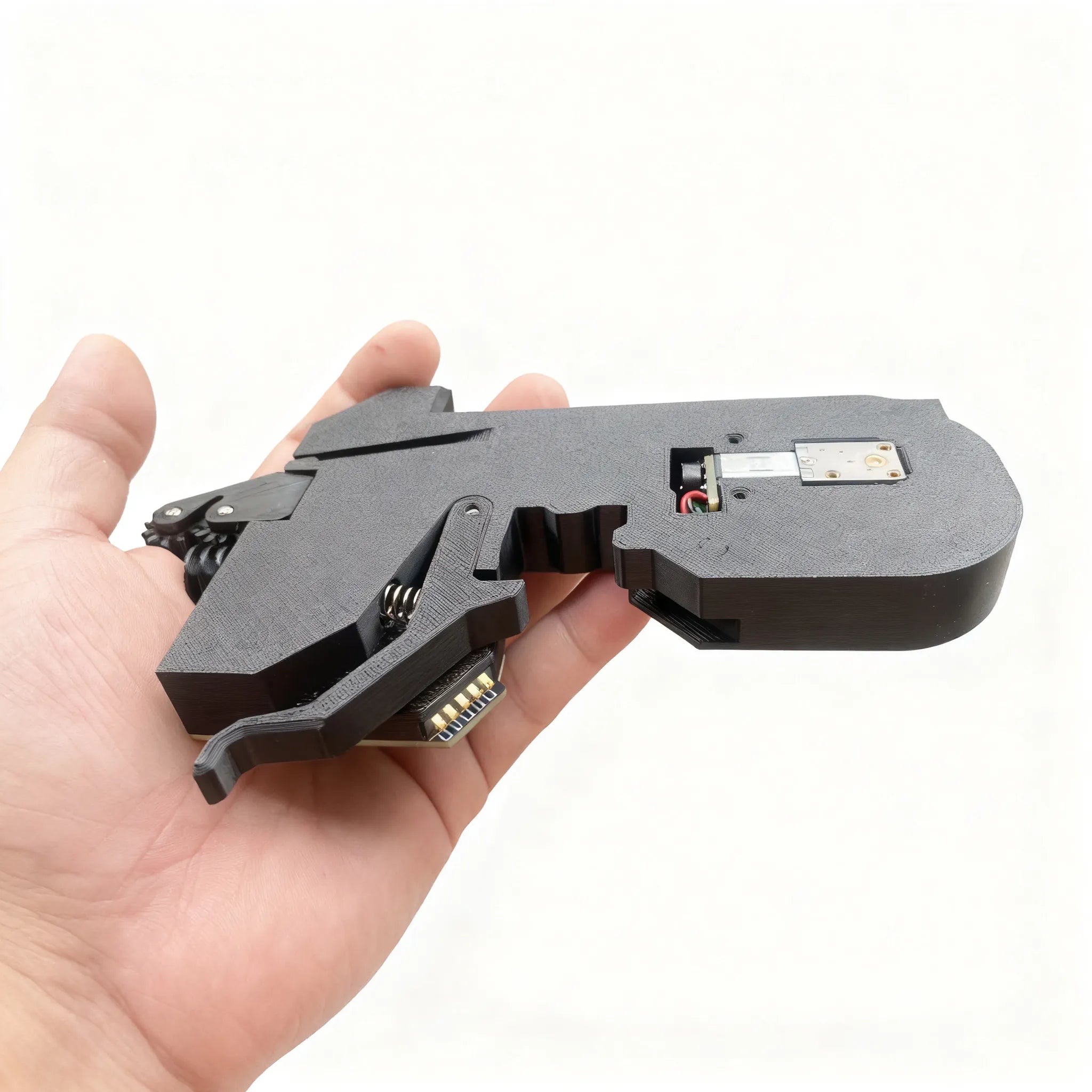
The paste side is cheaper in house as well. A frameless stencil starts at $3 for 100 × 100 mm with a 12 hour build, and stencils up to 280 × 280 mm ship in the box alongside your boards. A paste layer change costs a stencil instead of an order.
What does not improve: yield becomes your problem, and the process window is yours to find. Fifty slots is a hard ceiling on part number count in the same way that 50 boards is a ceiling on an Economic order.
How I split a project
The rules I use, all of them traceable to the arithmetic above:
- Design still moving. Assemble in house. The fixed block is charged per revision, and revisions are what you are buying.
- Design frozen, more than about 30 boards. Send it out. The marginal board costs cents.
- Between 16 and 30 extended part numbers at prototype quantity. Quote Standard before Economic.
- Parts already owned. Price the consignment route against buying from their library before shipping anything across a border.
- 0201, 01005, 0.35 mm pitch, more than 6 layers, or a panel over 250 × 250 mm. Economic is out, so the quote comes back on Standard or from your own bench.
- Mixed. Iterate at the bench and send the production run out. Nothing in the comparison forces a single answer.
Across my own board list the fixed block runs from $9.71 to $215.40 per revision depending on the BOM, while the joint counts span 12 to 1,164. The BOM moves the invoice further than the joint count does.